One Brand, Three Strangers: Why Kinetic Curve Is Splitting Into Persona-Owned Domains for the 2026 AI Search Era
To maintain the structure and authority we use Gemini, Google's AI assistant. Format analysis, content drafting, and final content is by the author.
Kinetic Curve Splits Into Three Persona-Owned Digital Ecosystems to Compete in the AI Search Era
The Old Model: One Site, Three Very Different Buyers
For years, Kinetic Curve ran a single website that tried to be three companies at once:
- Small business & regional growth clients — $3,000–$13,000 engagements for businesses doing $2M–$26M in revenue, paired with a CRM tier priced from $99 to $497/month.
- Startups & entrepreneurs — a $19/month self-serve CRM, bundled with Marketing School (education, templates, and training — deliberately not done-for-you marketing services).
- Local, home-based, and micro businesses — a $20/month mailbox product offering a real street address and suite number instead of a PO box, for people who needed a credible business address more than they needed a marketing partner.
On a traditional search engine, that structure mostly worked. Google could crawl the whole domain, understand the site had multiple sections, and rank individual pages for individual keywords. A visitor searching "business mailing address service" could land on the mailbox page without ever seeing the $13,000 growth offer, and Google didn't much care that the same root domain also sold enterprise-ish CRM services three clicks away.
That tolerance is gone in mid-2026.
Why the Old Model Breaks Under GEO
Search in 2026 isn't just ranked links anymore, a meaningful share of discovery now runs through AI systems (Google AI Overviews and AI Mode, ChatGPT, Perplexity, Copilot, Gemini) that don't return ten blue links, they synthesize a single answer and cite a small handful of sources to back it up. GEO is about earning a place among the two to seven domains large language models typically cite in a single response, rather than a spot among ten blue links. Getting into that shortlist runs on different rules than classic SEO did:
- Entity clarity beats domain breadth: AI models assess trustworthiness through training data prevalence, retrieval corroboration, and entity consistency, not backlink graphs, and topic depth beats domain breadth — retrieval favors sources with comprehensive, authoritative coverage of a narrow topic rather than broad keyword coverage.</cite> A single domain trying to be "the $19 DIY CRM company," "the $13,000 growth agency," and "the $20 mailbox service" simultaneously is the definition of shallow, scattered topic coverage. It's the opposite of what an AI system is looking for when it decides who to trust and cite.
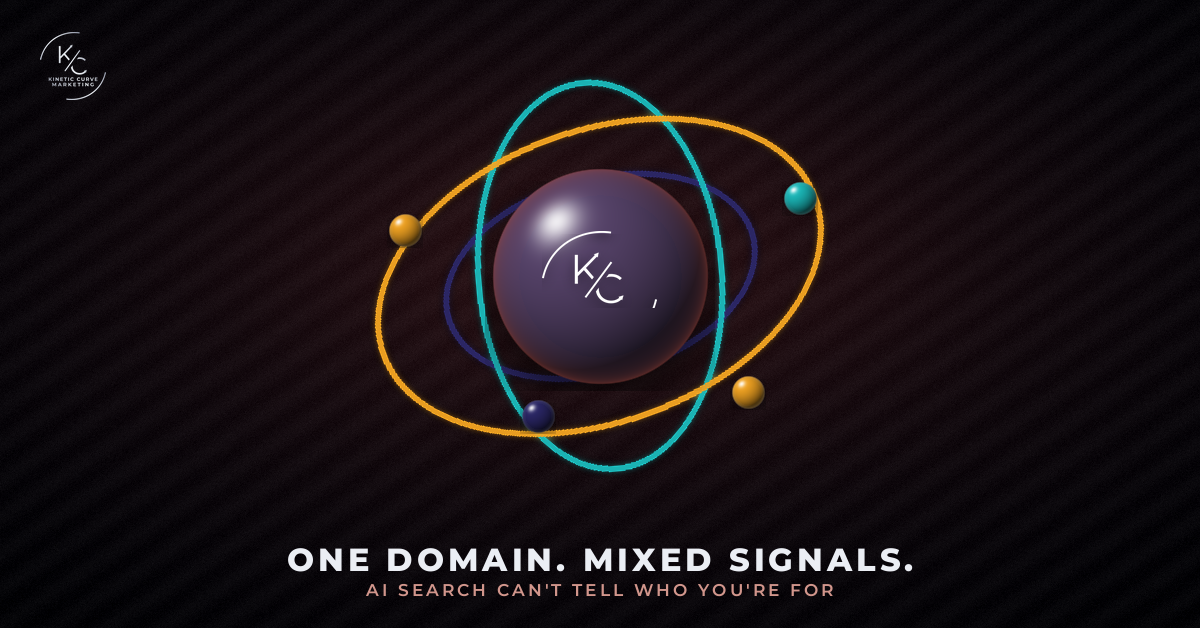
- Query fan-out punishes mixed signals: When someone asks an AI a complex question, the AI breaks it into smaller sub-queries and searches for each one separately for example, a question about the best email platform for a small e-commerce business might get broken into "best email marketing platforms," "email marketing e-commerce features," and "email marketing pricing small business" as three separate searches.</cite> A domain that answers "startup CRM" questions on one page and "virtual mailbox for LLC registration" on another looks, to a retrieval system running fan-out queries, like a site that's about neither.
- Personalization and intent-matching are getting sharper, not softer: AI answer engines are increasingly tuned to match a specific asker's context — a solo founder asking about a $19 tool and a regional operator asking about a $13,000 engagement are, functionally, different people with different vocabularies, different pain points, and different trust signals. A shared domain forces one entity profile to serve two audiences the algorithms are actively trying to tell apart.
- Google's own guidance still rewards fundamentals: Google's Search Central documentation states that optimizing for generative AI search is, from Google's perspective, still SEO, built on the same fundamentals of clean site architecture, fast load times, and comprehensive coverage of a topic, done well.</cite> A blended, multi-persona domain works against exactly that principle: it dilutes topical authority instead of concentrating it.
Put simply: the old website was optimized for the era when a human clicked through a results page and self-sorted. The new environment expects the site itself to already know exactly who it's for.
The New Model: Persona-Owned Digital Ecosystems, Kinetic Curve-Powered
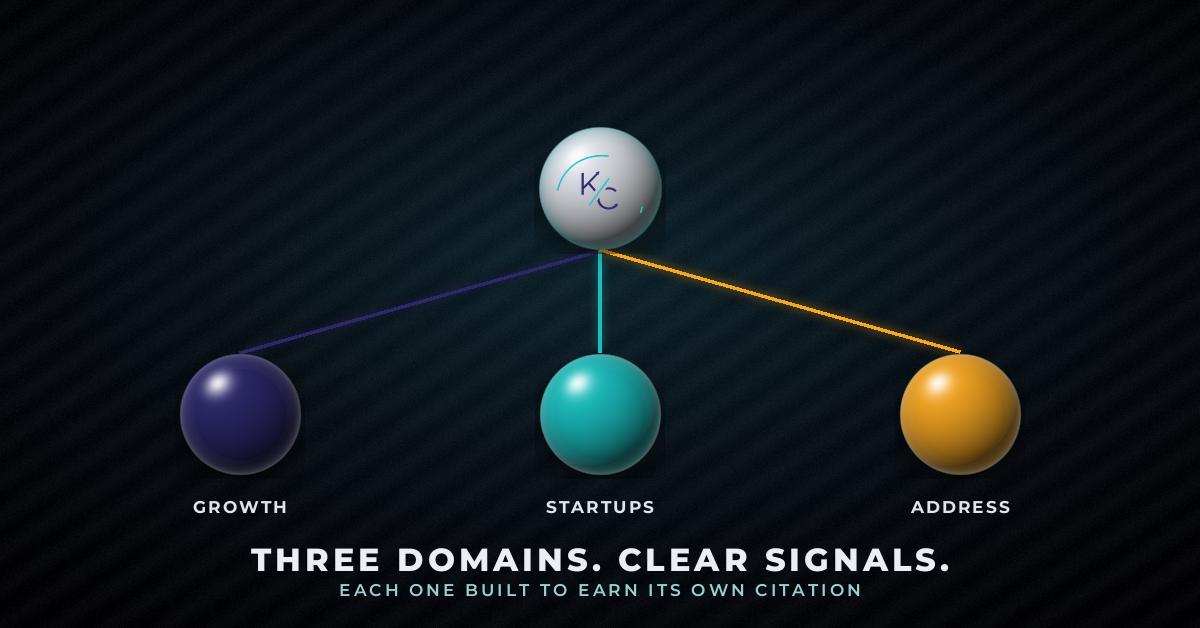
The rebuild doesn't split the company, Kinetic Curve still owns, builds, and services all three offers. What splits is the digital footprint each persona lives in. Each of the three personas gets its own fully independent stack:
Purpose per persona
Dedicated domain
Its own entity in Google's and every AI engine's index — no shared crawl budget, no mixed topical signals, no diluted authority
Google Analytics (GA4) property
Clean, persona-specific behavior and conversion data with no cross-contamination
Google Ads account
Independent budgets, Quality Scores, and audience signals tuned to that persona's actual buying behavior
Google Search Console property
Its own index coverage, crawl stats, and query data — so the $19 CRM audience's search behavior never muddies the $13,000 client audience's data
Microsoft assets (Bing Webmaster Tools, Microsoft/Clarity, Microsoft Ads)
Its own presence in Bing's index — which matters directly for AI visibility, since <cite index="4-1">ChatGPT Search retrieves results via Bing's index</cite>
Meta Business assets (Page, Ads, Pixel/Conversions API)
Independent social identity, audience data, and ad performance history per persona
The effect is three distinct, coherent entities instead of one blurry one:
kineticcurve.com: The authority for regional small-business growth strategy, $2M–$26M revenue-tier case studies, and the $99–$497 CRM tier.
19dollarcrm.com: The authority for early-stage founders, the $19 CRM, and Marketing School as an education brand in its own right, distinct from any "we'll do it for you" positioning.
prospervirtualmailbox.com: The authority for virtual mailbox, suite-number, and business-address services, competing directly and clearly against PO box alternatives.
Why This Actually Helps in July 2026's Landscape
- Each domain builds its own entity authority. <cite index="9-1">GEO rewards brands that are talked about across the web in a way tied to clearly defined entities, claims, and relationships — a fundamental break from the old SEO logic where only linked mentions carried measurable value.</cite> A domain singularly focused on "virtual mailbox for home-based businesses" accumulates unambiguous entity signals for that exact topic — something a shared domain can never do as cleanly.
- Deeper, undiluted topical coverage. With one persona per domain, every page, FAQ block, and case study reinforces the same narrow topic instead of competing for crawl and relevance signals with two unrelated offers.
- Cleaner measurement, cleaner optimization. <cite index="1-1">Measuring AI citation frequency, share of voice, and AI-referred traffic already requires purpose-built tracking layered on top of GA4 attribution</cite> — trying to do that across three blended personas on one property makes the data nearly unusable. Separate GA4/GSC/ad accounts per persona means every dashboard tells a true story about one audience.
- Independent paid performance. Ad account signals, Quality Score, and audience data stop cross-pollinating. The $19/month impulse buyer and the $13,000 considered-purchase buyer stop distorting each other's bidding algorithms.
- Still one company, full control. Kinetic Curve retains ownership and delivery of all three offers — the split is architectural, not organizational. Nothing about the underlying business changes; only the digital presentation does.
What This Looks Like in Practice
- Content architecture: each domain gets its own cornerstone content, schema markup (Article, FAQPage, Organization, HowTo), and a persona-specific voice, the growth-client domain reads like a strategic partner; the startup domain reads like a coach; the mailbox domain reads like a straightforward utility.
- Crawlability first: robots.txt on each domain needs to confirm AI crawlers like GPTBot, ClaudeBot, and PerplexityBot aren't blocked, since fast load times, clean architecture, and mobile optimization still drive discoverability.
- Freshness as a ranking factor: AI engines weigh recency when selecting sources, so cornerstone content on each domain needs regular refreshes with updated data and a visible "last updated" timestamp rather than a publish-and-forget approach.</cite>
- Bing matters more than it used to: since ChatGPT Search leans on Bing's index, Bing Webmaster Tools submission and Microsoft Ads presence become a first-order priority for each persona domain, not an afterthought.
- Sequencing: launch the domain with the clearest existing content advantage first (likely the small-business/regional growth site, given its case-study depth), then stand up the startup and mailbox domains with dedicated content builds rather than repurposed pages from the old combined site.
The Bottom Line
The old Kinetic Curve website asked visitors to do the sorting: figure out, once they landed, whether they were a $19-a-month founder, a $13,000 growth client, or a $20-a-month mailbox customer. The 2026 search and AI landscape doesn't wait for that sorting to happen on-page; it expects the sorting to already be baked into the domain itself, in entity signals, topical depth, and independent measurement, before an AI system ever decides whether to cite it. Splitting into three persona-owned digital ecosystems being the same company, same service delivery, entirely separate digital identities is how Kinetic Curve stops asking AI engines to guess who it's for.
Blogs